
Utah Just Planned the Next 30 Years of Fishing. And It Might Not Look Like the Past

This feature was written by The Fly Box and published in Casts That Care, our charity-driven fly fishing newsletter.
Casts That Care delivers real stories, deep dives, and the heart of the fly fishing world while donating 50% of all subscription fees to a different fishing-related nonprofit each month. This month it is Warriors & Quiet Waters
Use code “WQWF15” for 25% off your first month, and we’ll donate an extra 15% to support their mission.

A Long Term Shift Is Coming to Western Fisheries
In March, the Utah Division of Wildlife Resources released a comprehensive long term strategy focused on fish production and stocking across the state. This is not a short term adjustment or a seasonal regulation update. It is a 30 year plan that outlines how Utah intends to raise, stock, and manage fish populations through changing environmental conditions and increasing angler demand.
At its core, the plan recognizes a reality that is becoming harder to ignore across the West. The waters anglers have relied on for decades are changing, and the systems used to manage those waters must evolve alongside them.
What Utah is Actually Saying
The plan identifies several long term pressures that are already affecting fisheries across the state. Water temperatures are increasing in many systems, particularly during summer months. Drought cycles are becoming more frequent, which reduces reservoir levels and stream flows. Lower water levels also concentrate fish populations, increase stress, and reduce the amount of available coldwater habitat.
These conditions directly impact trout, which require cold, oxygen rich water to survive and reproduce. Even small increases in temperature can reduce growth rates, increase mortality, and limit natural reproduction. In tailwaters and high elevation systems, trout may remain stable, but in lower elevation reservoirs and streams, conditions are becoming less reliable.
The plan acknowledges that these environmental changes are not temporary. They are part of a longer trend that will shape fisheries over the next several decades.
Quote from DWR Sportfish Coordinator Trina Hedrick
“We want anglers to know that we hear the projections for Utah, and we see and experience the changes in our fisheries as well... We face a number of challenges for effective fish conservation and management in the coming years, and we can’t do it alone. If we are going to address these challenges, we need help from the anglers who enjoy fishing in Utah. We are increasing our efforts to better understand fishing experiences at many of Utah’s waters, and over the next few years, anglers may see more requests to provide feedback about their fishing experiences, especially as some of the stocking changes are implemented. Public satisfaction is a key component of our sportfish management actions and receiving feedback is crucial to these efforts. This plan will help us navigate the future more clearly and more efficiently.”
A Shift Away From Trout Everywhere
One of the most significant conclusions in the plan is that not all waters will continue to support trout at the same level they have in the past. In some cases, trout may still be stocked, but survival rates may decline. In other cases, agencies may need to reconsider whether stocking trout is the best long term use of resources.
As a result, Utah is preparing for a future where certain fisheries transition toward warmwater species such as bass, bluegill, or other panfish that are better suited to warmer and more variable conditions. These species are more tolerant of higher temperatures and lower oxygen levels, which makes them more stable in reservoirs and low elevation systems.
This represents a meaningful shift in management philosophy. For decades, trout have been the default species across many western fisheries, even in waters that require ongoing stocking to maintain populations. Moving away from that model in select locations signals a broader change in how fisheries are evaluated and managed.
Hatcheries Are Becoming More Strategic
Utah is not reducing its reliance on hatcheries. Instead, it is refining how hatchery production is used. The plan emphasizes producing fish that are better matched to the environments where they will be stocked. This includes adjusting species selection, stocking sizes, and release timing to improve survival rates and overall fishery performance.
Hatcheries will continue to play a critical role in maintaining fishing opportunity, particularly in waters where natural reproduction is limited or inconsistent. However, the focus is shifting from simply producing large numbers of fish to producing the right fish for specific conditions.
This approach reflects a broader trend in fisheries management. Agencies are moving toward more targeted and data driven strategies rather than relying on uniform stocking practices across all waters.
Year | Fish Stocked in Utah |
2020 | 8.2M |
2021 | 9.6M |
2022 | 8.2M |
2023 | 10.6M |
2025 | 11.66M |
Native Fish and Angler Expectations Coexist
Another key component of the plan is balancing native species conservation with recreational fishing opportunity. Utah has ongoing efforts to restore and protect native fish populations, including Bonneville cutthroat trout and other species that have been historically displaced or reduced.
At the same time, recreational fishing remains an important part of the state’s outdoor economy and culture. Anglers expect consistent opportunity, which often depends on stocking programs and accessible fisheries.
These goals do not always align. Increasing native fish protections can limit stocking in certain areas, while maintaining high catch rates may require continued hatchery support. The plan addresses this by identifying waters where native restoration will be prioritized and others where recreational opportunity will remain the primary focus.
This is Bigger Than Utah
Utah’s plan stands out because it clearly defines how fisheries management is adapting to long term change. However, the challenges it outlines are not unique to the state. Across the West and throughout the United States, agencies are facing similar conditions, including warming water, increased fishing pressure, and reduced habitat stability.

In response, fisheries are becoming more actively managed systems. Decisions about species, stocking rates, and habitat use are increasingly based on environmental data, long term projections, and angler demand.
The idea of a stable, unchanging fishery is becoming less realistic in many regions. Instead, fisheries are being continuously adjusted to maintain both ecological function and recreational access.
A Different Version of the Future
For anglers, this raises an important question. What does fly fishing look like if fewer waters are consistently managed for trout
In some areas, anglers may need to adapt by targeting different species or fishing different types of water. Warmwater fisheries may become more common in places that were once known primarily for trout.
In other areas, coldwater fisheries may become more valuable and more carefully protected. High elevation streams, spring fed systems, and tailwaters may take on increased importance as reliable trout habitat.
The overall experience of fly fishing may become more varied, depending on location and environmental conditions.
The Takeaway
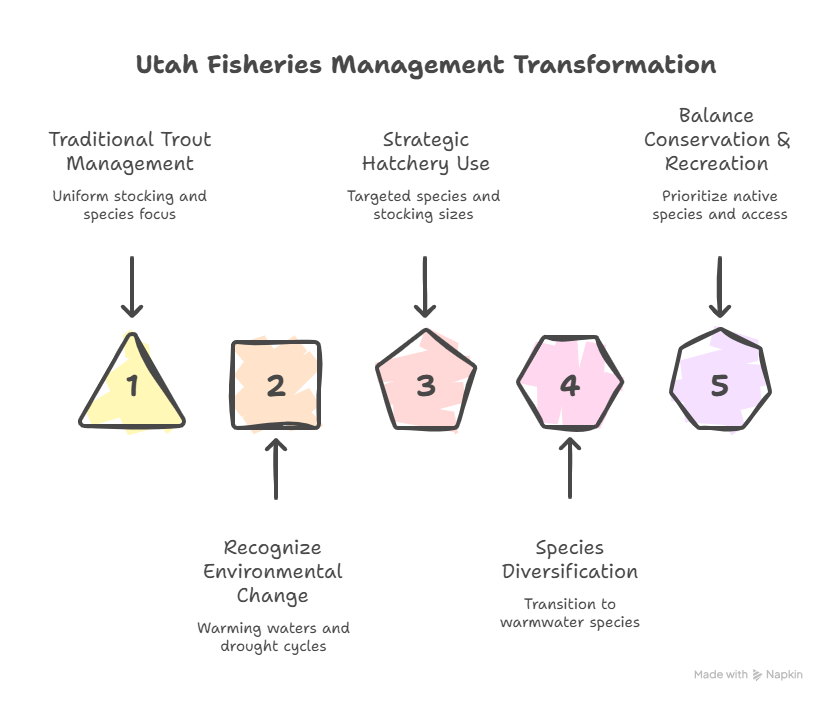
Utah’s 30 year plan is not about removing trout from the landscape. It is about recognizing that environmental conditions are changing and that fisheries management must respond in a structured and long term way.
The plan shows a shift toward more strategic hatchery use, more targeted species management, and a clearer balance between conservation and recreation.
For anglers, this means the future of fishing will not be defined by a single model. It will depend on how each fishery is managed based on its specific conditions.
For Anglers Paying Attention
This type of planning does not generate daily headlines, but it has long term consequences for how and where people fish. Decisions made today about stocking, species selection, and habitat management will shape fisheries for decades.
Utah has made those decisions visible through a 30 year framework. Other states are likely to follow with similar approaches as they face the same environmental and recreational pressures.
This feature was written by The Fly Box and published in Casts That Care, our charity-driven fly fishing newsletter.
Casts That Care delivers real stories, deep dives, and the heart of the fly fishing world while donating 50% of all subscription fees to a different fishing-related nonprofit each month. This month it is Warriors & Quiet Waters
Use code “WQWF15” for 25% off your first month, and we’ll donate an extra 15% to support their mission.


Comments