
The Fish That Was Worth More Than Gold: How The Miners in the Pikes Peak Gold Rush Survived
- The Fly Box LLC

- Apr 15
- 4 min read
This feature was written by The Fly Box and published in Casts That Care, our charity-driven fly fishing newsletter.
Casts That Care delivers real stories, deep dives, and the heart of the fly fishing world while donating 50 percent of all subscription fees to a different fishing-related nonprofit each month.

The Rush West
Thousands of men came west chasing gold. But the thing that kept them alive had nothing to do with it.
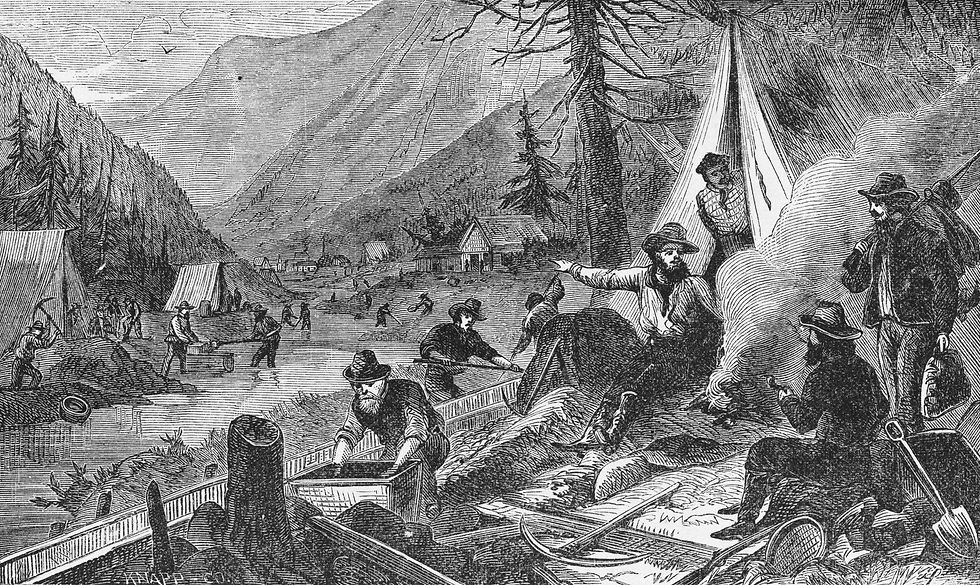
In 1859, news of gold in the Rocky Mountains triggered what became known as the Pikes Peak Gold Rush. Within months, tens of thousands of prospectors flooded into what is now Colorado. By the end of that year, the population had surged past 100,000 people, many of them inexperienced, underprepared, and chasing a dream that very few would actually realize.
They followed rivers like the South Platte, not because they were anglers, but because that’s where the gold was. Early mining relied on placer techniques, where prospectors sifted through river sediment in search of flakes and nuggets. The river was everything. It was the road, the workplace, and the reason these camps existed at all.
But it quickly became something else.
A Harsh Reality
Mining towns sprang up almost overnight. Places like Oro City ballooned into thousands of residents in a matter of weeks. But infrastructure didn’t follow. Supply chains were inconsistent at best and nonexistent at worst. Food became a problem almost immediately.

Basic goods had to be hauled in by wagon over long, dangerous distances. Prices soared. Fresh meat was rare. Vegetables were nearly impossible to find. Most miners relied on a repetitive and limited diet of salt pork, beans, flour, and coffee. It kept them alive, but barely.
Because here’s the reality that defined the gold rush: you can’t eat gold.
Gold had value. Food had power.
A man could strike gold and still go hungry. But a man who could reliably eat had a far better chance of surviving long enough to strike anything at all.
The River Becomes Survival
The same rivers that drew miners west began to serve another purpose. They became a source of life.
The waters of the Rocky Mountains were home to native cutthroat trout, fish that had lived in these cold, clear streams long before miners ever arrived. These weren’t stocked fish or introduced species. They were part of the landscape itself.
In the South Platte drainage, that meant fish like the greenback cutthroat trout, a native species that still exists today and is now listed as a federally threatened fish.
Miners were not surviving solely on trout, but in an environment where food was scarce and expensive, any reliable source mattered. A fish pulled from the river meant one less meal purchased, one less dependence on unstable supply lines, and one more day with the strength to keep working.
In that environment, even small advantages made a difference.
These fish were not trophies. They were not part of a sport. They were part of survival.
A Different World Back East
While miners struggled to find reliable food in the mountains, a very different system had already taken shape along the Atlantic coast.
There, Atlantic cod had become one of the most important food sources in the world. Fished in massive numbers off the coasts of Newfoundland and New England, cod was salted and dried so it could last for months or even years without spoiling.
It fed entire populations across Europe, the Caribbean, and North America. It was predictable, transportable, and dependable in a way that food in the West simply was not.
Some of that preserved fish did make its way inland, including to mining regions, but it was never as reliable or accessible as the resource that was already there.
The river.

What This Means Today
Today, fly fishing is often framed around gear, travel, and the pursuit of larger fish. But long before any of that existed, fish represented something far more fundamental.
They were stability.
They were a fallback when everything else failed.
The same native cutthroat trout that once lived quietly in these rivers are still there today, in some places, holding on in the same waters that once supported entire communities of people chasing something else entirely.
The Takeaway
Gold built the towns. But it did not sustain them. The fish did.
Not imported. Not stocked. Native cutthroat trout.
Fish that were already there, long before the first pan hit the water, and long after the gold was gone. The most valuable thing in the gold rush wasn’t gold. It was whatever you could depend on.
And in the rivers of Colorado, that meant native trout.
This feature was written by The Fly Box and published in Casts That Care, our charity-driven fly fishing newsletter.
Casts That Care delivers real stories, deep dives, and the heart of the fly fishing world while donating 50 percent of all subscription fees to a different fishing-related nonprofit each month.


Comments