
Rod Warranties: The History, Economics, and Future of Fly Fishing’s Boldest Promise

This feature was written by The Fly Box and published in Casts That Care, our charity-driven fly fishing newsletter.
Casts That Care delivers real stories, deep dives, and the heart of the fly fishing world while donating 50 percent of all subscription fees to a different fishing-related nonprofit each month.

Walk into almost any modern fly shop and pick up a premium fly rod. Somewhere on the packaging, the website, or the product description, you will likely see a promise that has become deeply embedded in fly fishing culture.
A long-term rod warranty.
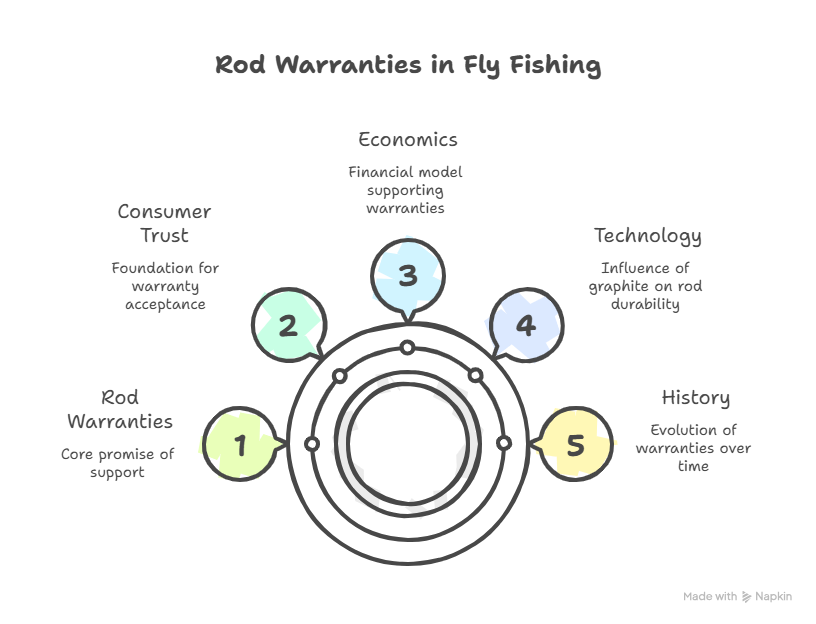
Today that promise is so common that many anglers assume it has always existed. But the modern fly rod warranty is a relatively recent development. Its rise tells a story about technology, consumer trust, and the economics of the fly fishing industry.
What began as a practical solution to reassure anglers about expensive graphite rods eventually became one of the defining marketing commitments in fly fishing equipment.
Before Graphite, Warranties Were Rare
For most of fly fishing history, rod warranties were not part of the conversation.
Early fly rods were typically built from split bamboo or later fiberglass. These rods were crafted by individual makers or small companies and repairs were simply part of the relationship between builder and angler. If a rod broke, it was usually sent back to the maker for paid repair work.
The economics of handcrafted rods did not lend themselves to broad guarantees. Rod builders operated more like craftsmen than modern consumer brands. They stood behind their work, but formal warranty programs were uncommon.
The Graphite Revolution
The fly rod world began to change in the 1970s with the arrival of graphite.
Graphite rods were lighter, faster, and capable of generating higher line speeds than the fiberglass rods that dominated the previous era. By the early 1980s, graphite had become the dominant material in premium fly rod design.
But graphite introduced a new challenge.
Early Ads For Graphite Rods
While extremely strong for its weight, graphite rods could be brittle under sudden impact. A rod tip slammed in a car door, struck against a rock, or over-stressed while fighting a fish could fail catastrophically.
As fly rods became more technologically advanced and more expensive, manufacturers faced a growing problem. Anglers were being asked to spend hundreds of dollars on equipment that could break in an instant.
Manufacturers needed a way to build confidence in these new high-performance rods.
The Late 1980s Turning Point
One of the most influential moments in the history of rod warranties arrived in 1988 when Orvis introduced a 25 year guarantee on its fly rods. The policy promised to repair or replace rods for 25 years, even when the damage was clearly caused by accidents rather than manufacturing defects.
While it is difficult to say definitively that this was the first warranty of its kind, it was one of the earliest major long-term guarantees to be marketed widely within the fly fishing industry.
The idea was simple. If anglers were already sending broken rods back for repair, the company might as well stand behind the product publicly and make that support part of the brand.
The move reshaped expectations.
Soon other manufacturers expanded on the idea. Some brands began offering lifetime warranties or other long-term service policies, helping establish the modern expectation that premium fly rods would be backed by the company that built them.
Early Ads For Fly Rod Warranties
When the Warranty Became Part of the Product
By the 1990s, long-term rod warranties were no longer unusual. In many cases they had become a central selling point.
The warranty was not simply a safety net. It was a promise of long-term partnership between angler and manufacturer.
For anglers, the logic was easy to understand. Spending several hundred dollars on a rod felt less risky if the manufacturer guaranteed that the rod could be repaired or replaced.
For manufacturers, the warranty created something equally valuable.
Trust.
The Economics Behind the Promise
At first glance, offering long-term warranties might seem financially dangerous for rod companies. Replacing broken rods and running repair departments requires materials, labor, and inventory.
But the economics are more complex than they appear.
Most rods sold will never be returned for repair. Those that are returned often involve service fees that help offset repair costs. Manufacturers also factor warranty costs into product pricing alongside materials, labor, and distribution.
In this way, the warranty becomes part of the overall economic model rather than a separate expense.
Equally important is the effect on customer loyalty.
When anglers have a positive warranty experience, they are far more likely to buy from that same brand again. A broken rod that is repaired quickly can strengthen a company’s reputation rather than damage it.
Across consumer industries, warranties are widely recognized as tools that increase buyer confidence and long-term brand loyalty.
Fly fishing companies discovered the same principle.
The Modern Warranty Landscape
Today the fly rod warranty landscape is more nuanced than many anglers realize.
Some companies still offer lifetime warranties. Others provide limited lifetime coverage for the original owner. Some brands maintain fixed guarantees such as 25 year coverage. Nearly all require service fees or shipping costs for repairs that result from accidental damage.
In other words, modern warranties are rarely unconditional promises.
They are structured support systems designed to balance customer service with the real costs of manufacturing and repair.
The Future of Rod Warranties
As materials and manufacturing continue to evolve, the future of rod warranties may shift again.
Some companies have already moved toward more detailed warranty language focused on defects in materials and workmanship rather than unconditional replacement policies. Others have expanded repair programs that prioritize fast turnaround rather than broad replacement promises.
At the same time, the cultural expectation created over the past several decades remains powerful.
Modern anglers have come to expect that the companies behind their rods will stand behind the product.
That expectation may ultimately prove to be the most important legacy of the fly rod warranty.
More Than a Guarantee
In the end, rod warranties represent more than a repair policy.
They represent a relationship.
The angler invests in a piece of equipment built for precision and performance. The manufacturer promises that if something goes wrong, they will still be there to support it.
In an industry built around trust, craftsmanship, and time on the water, that promise has become one of fly fishing’s boldest ideas.
This feature was written by The Fly Box and published in Casts That Care, our charity-driven fly fishing newsletter.
Casts That Care delivers real stories, deep dives, and the heart of the fly fishing world while donating 50 percent of all subscription fees to a different fishing-related nonprofit each month.


Comments